



















PEB Construction — Turnkey Steel Buildings in 45 Days
PEB construction with SAMAN means one contract, one project manager, and one entity accountable from ground survey to building handover — not three separate contractors who are not accountable to each other.
One Contract. One Project Manager. One Handover.
Most industrial project owners who have built before have managed the fragmentation: a civil contractor for the foundation, a steel supplier who delivers to site, and an erection crew that the steel supplier does not employ. When the erection crew finds a discrepancy in the foundation layout, nobody owns the problem. The project stops. The delay is yours.
A SAMAN PEB construction project eliminates this entirely. Structural design, IS-code documentation, factory fabrication, transport to site, and erection by our own crew are all under one contract. One call resolves any site issue. One entity is responsible for the handover certificate.
We manufacture from our facilities in Bangalore and Greater Noida and have constructed PEB buildings across India for factories, warehouses, logistics parks, and commercial facilities from 500 sq ft to 50,000 sq ft.
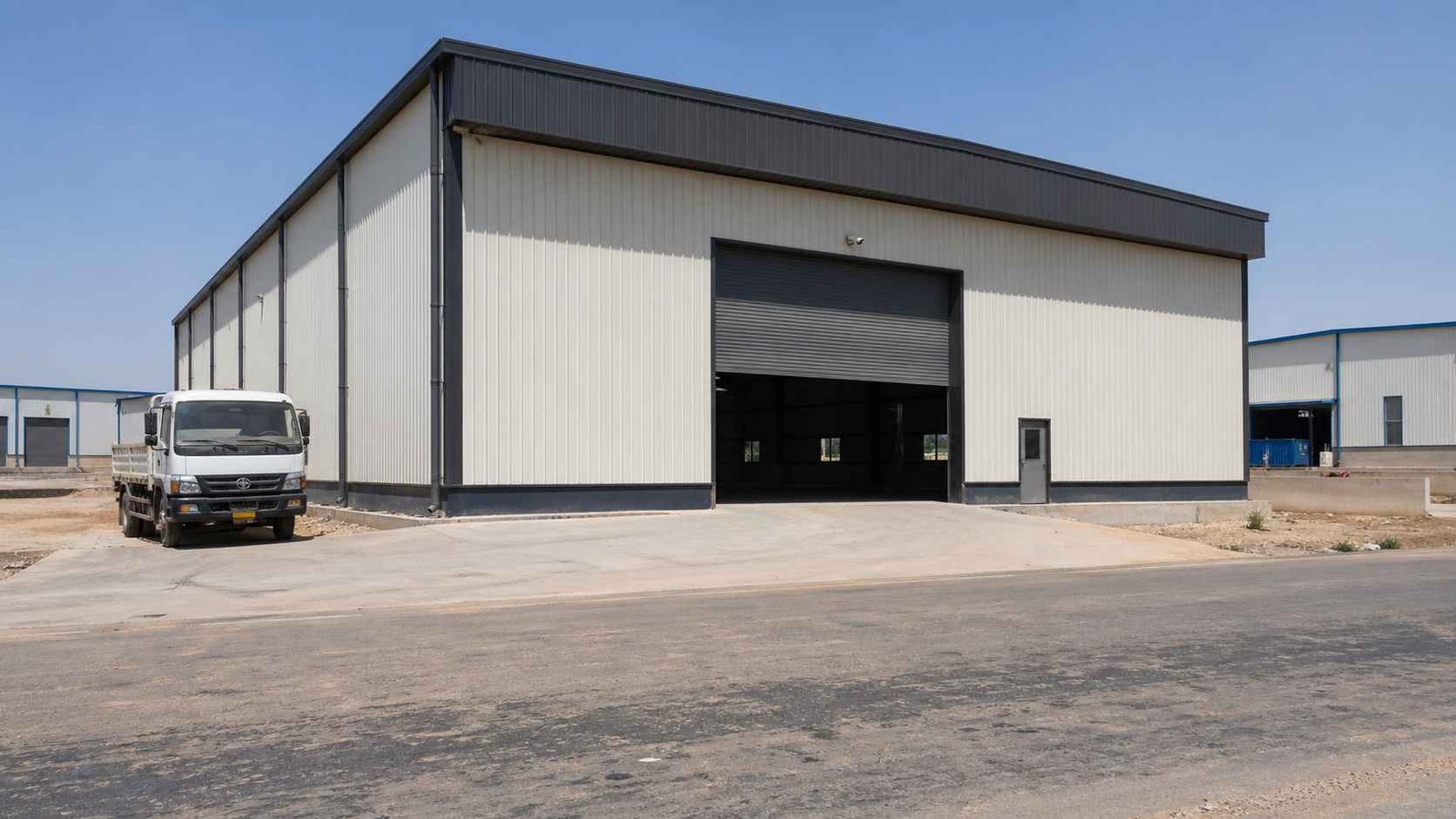
Completed SAMAN PEB construction project at an Indian industrial zone — colour-coated steel cladding, roller shutter entry, and concrete apron. One contract, one contractor, from site survey to building handover.
The Single-Contract Scope — Exactly What Is Included
A SAMAN PEB construction contract covers structural design, preparation of IS-code documentation for your approval submission, factory fabrication of all structural components, quality control at fabrication stage, transport of all components to your site in a coordinated batch, site erection by our own trained crew, final structural inspection, and project handover with as-built drawings, IS-compliance certificate, and warranty documentation.
Three items fall outside SAMAN’s scope and are arranged by you. Civil foundation work — column footings and anchor bolt setting — is executed by your civil contractor using the layout drawing we provide within 5 working days of order confirmation. Your contractor pours the foundation in parallel with our fabrication phase so no time is lost. Site access — an approach road that takes a loaded 40-foot flat-bed truck — must be confirmed before we dispatch. Utility connections to the completed structure — electrical, plumbing, and drainage — are arranged by you after structural handover.
Statutory building approval is your submission. We provide every document required — structural drawings, IS-code calculation report, and engineering sign-off — but the application and any local authority fees are between you and the industrial authority.
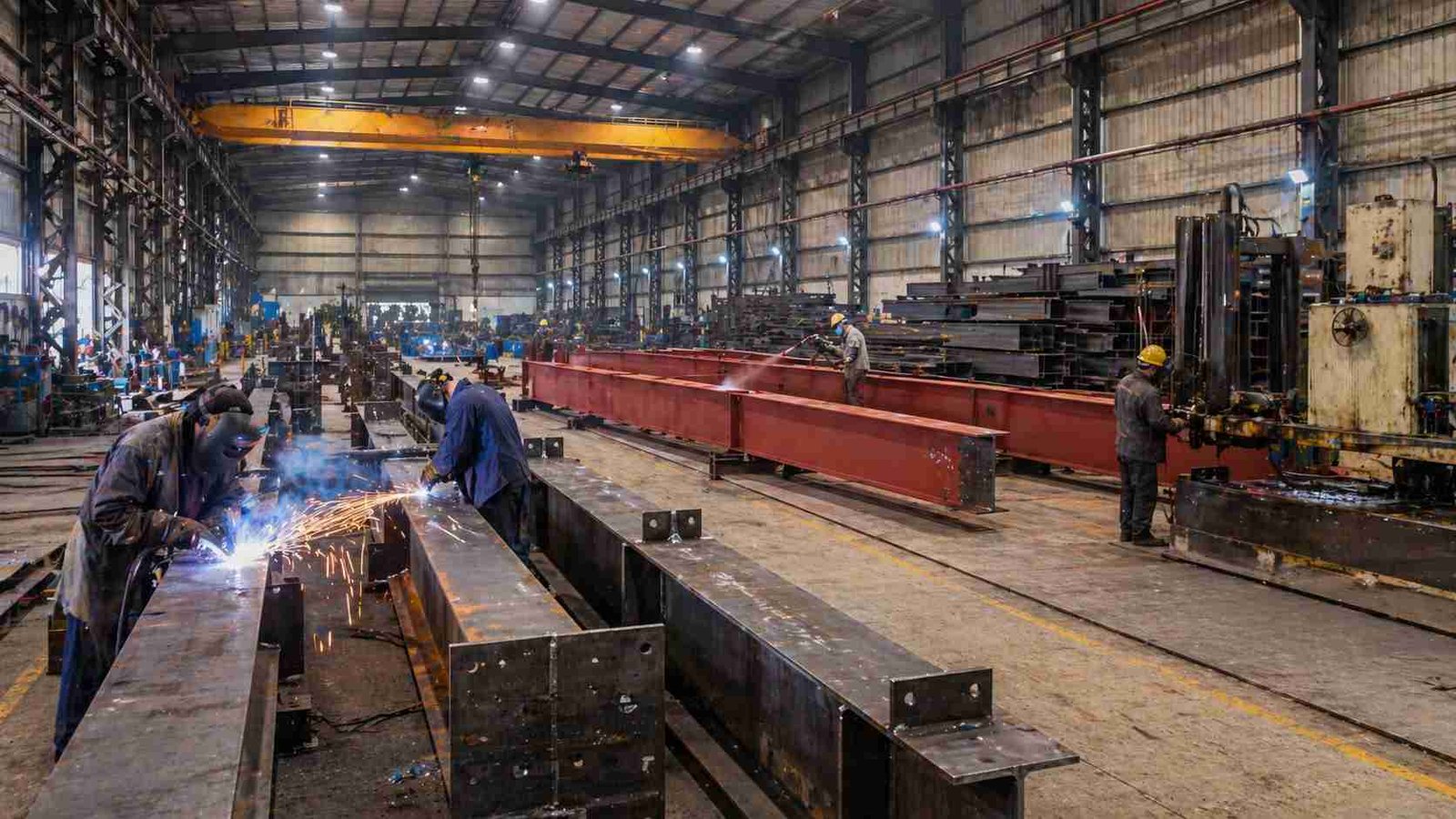
Inside SAMAN’s steel fabrication facility — primary PEB frames being welded, drilled, and primed for dispatch. All structural components are fabricated in-house at our Bangalore and Greater Noida facilities before being transported to your site.
For buyers who want to review the complete construction scope before committing, our prefabricated construction subpage covers the full service scope.
IS 800, IS 875, IS 1893 — Why These Three Codes Matter for Your Approval
Every SAMAN PEB construction project is designed to three specific Bureau of Indian Standards codes — and this matters for your building approval process, not just structural performance.
IS 800 governs the design of structural steel members — how columns, rafters, and bracing are sized and connected. IS 875 sets the wind and dead load parameters for your specific location — a building in coastal Gujarat is designed to different wind pressures than one in inland Karnataka. IS 1893 covers seismic design — your structure is engineered to the seismic zone of your site.
For project owners on industrial zone plots — GIDC in Gujarat, SIDCO in Tamil Nadu, KIADB in Karnataka, RIICO in Rajasthan, and equivalent bodies across India — building approval applications require a structural calculation report confirming compliance with these three codes, signed by a licensed structural engineer. SAMAN provides the full structural calculation documentation, design drawings, and IS-code compliance report with every project as a standard inclusion — not a paid add-on.
For buyers specifically evaluating our engineering compliance and structural design capability, our engineered buildings subpage covers the design and engineering process in detail.
What a PEB Construction Project Costs — and What Moves the Number
A standard SAMAN PEB construction project — complete design, fabrication, transport, and site erection — costs Rs 900 to Rs 1,500 per sq ft for the full service. For a 10,000 sq ft factory or warehouse, total project cost runs Rs 1.2 to Rs 1.5 crore. For a 25,000 sq ft logistics facility, Rs 2.5 to Rs 3.5 crore.
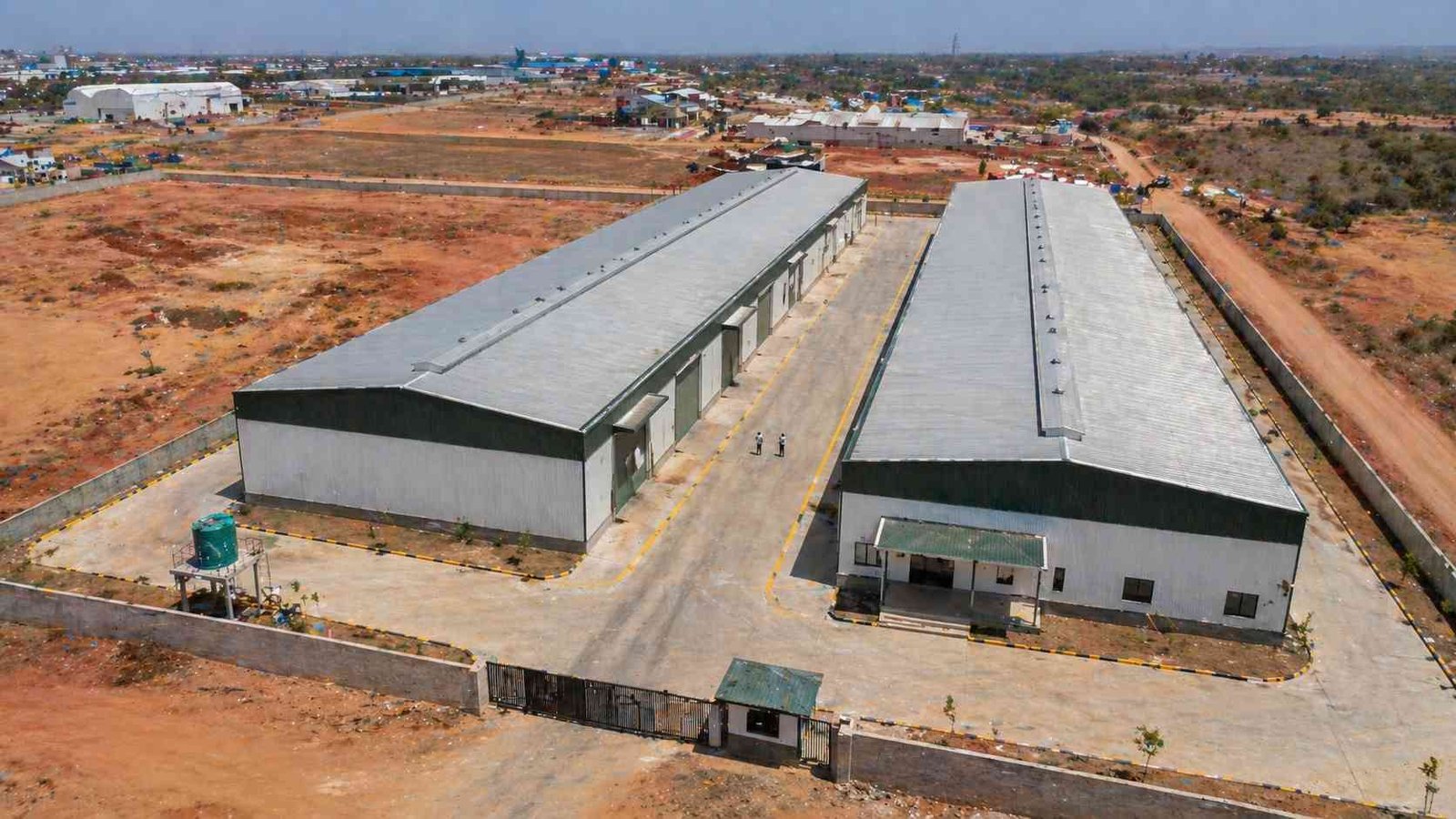
Aerial view of a completed SAMAN multi-bay PEB construction complex at an Indian industrial zone — two factory buildings with galvalume roofing, internal road, roller shutter access, and perimeter security. Total covered area: 50,000 sq ft. Single contract, 45-day delivery.
Equivalent conventional RCC construction for the same usable area costs Rs 1,400 to Rs 2,200 per sq ft — before accounting for the 9 to 14-month construction timeline versus our 45-day completion.
Five variables move the cost within the Rs 900–1,500 range. Span width — wider spans require heavier primary frames. Clear height — taller eave heights add to column size and wind load requirements. Crane provision — an EOT crane bay changes column specification, foundation load, and tie rod design — confirm your crane requirement before we issue the drawing. Cladding grade — Galvalume standard versus colour-coated or PUF insulated panels. Site distance — projects beyond 300 km from our Bangalore or Greater Noida facilities carry additional transport cost confirmed at quote stage.
For buyers who want to understand the manufacturing cost component — how steel tonnage is calculated and how fabrication quality affects total project value — our peb building manufacturers subpage covers this in detail.
From Your First Call to Building Handover — 45 Days
The project begins with a site visit. Our structural engineer visits your plot to confirm dimensions, soil bearing capacity, and access conditions. You share your building use requirements, span and height preferences, and any crane specification. Within 3 days of the site visit, we issue a structural brief and preliminary cost estimate.
Structural design and documentation follow over the next 8 to 10 days. Our engineers prepare IS 800, IS 875, and IS 1893 compliant structural drawings, load calculations, and engineering certificate — ready for your industrial authority submission. While we design, you initiate the building plan approval process in parallel. This concurrent approach is the most common cause of time saving on PEB construction projects.
Factory fabrication at our Bangalore or Greater Noida facility runs from approximately day 5 to day 30. All primary portal frames, secondary purlins, girts, roof sheets, wall cladding, gutters, and accessories are fabricated and quality-checked. During this same window, your civil contractor pours the column footings and sets anchor bolts using our layout drawing.
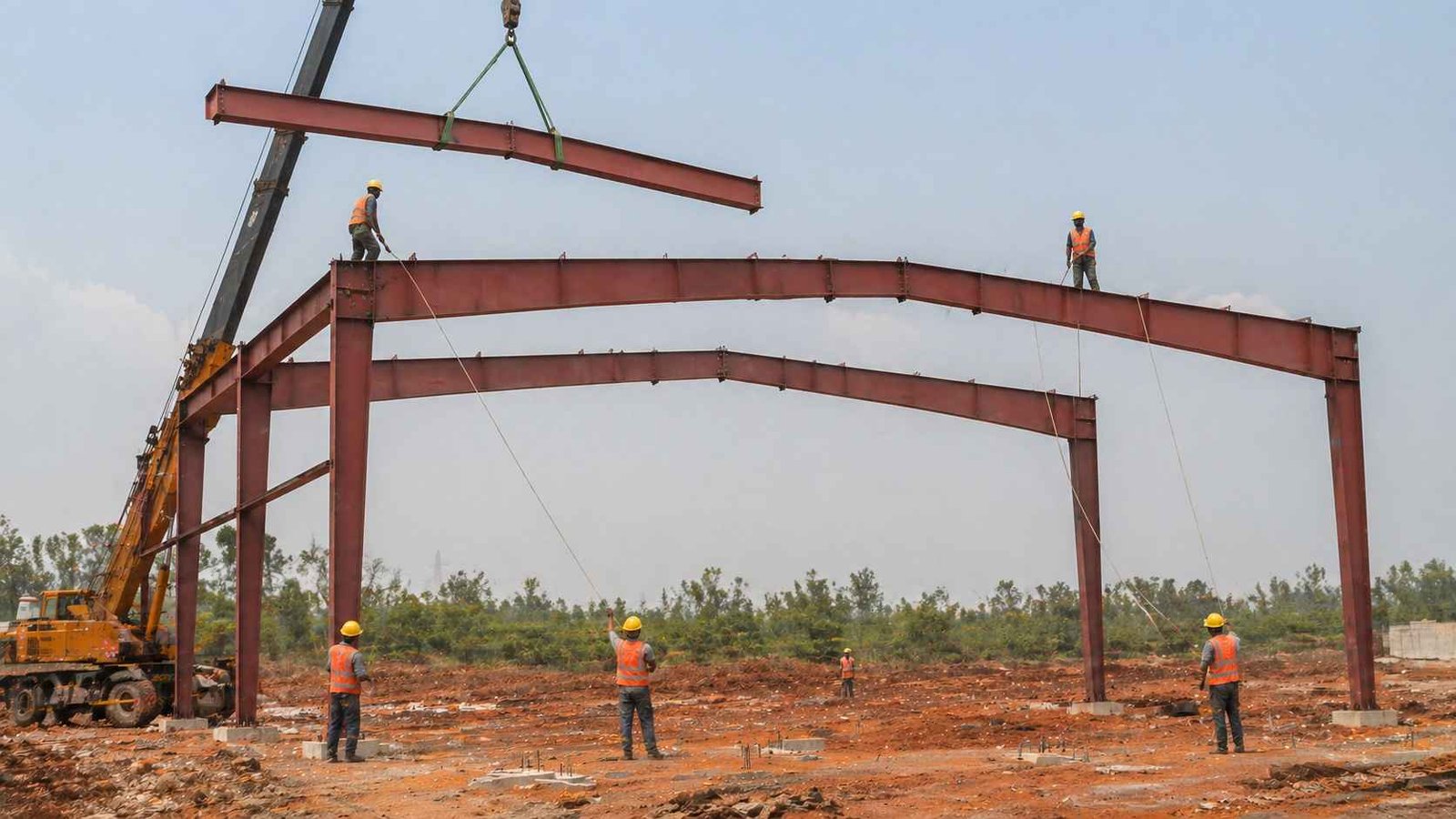
SAMAN PEB construction erection crew assembling primary portal frames on site. Factory-fabricated components are bolted together by our own erection team — not a subcontracted crew. Standard configuration up to 15,000 sq ft completes erection in 10 to 14 working days.
Dispatch and transport to your site takes 3 to 5 days. Before dispatch, you confirm that crane access is arranged and the site approach road accepts a loaded flat-bed. Our erection crew arrives with the components and works for 10 to 14 days to complete structural assembly, roofing, cladding, and accessories installation. Final inspection, snag rectification, and handover follow.
Total from order confirmation to keys: 45 days for standard configurations up to 15,000 sq ft. Projects above 25,000 sq ft run 55 to 65 days.
For buyers evaluating structural assembly quality across erection stages, our pre-engineered structures subpage covers the structural assembly detail.
Building Types We Construct
Factory and manufacturing facilities: Production floors from 500 sq ft to 50,000 sq ft. Crane-ready configurations available from 15m span. Multi-bay factories with attached office blocks delivered under a single contract.
Warehouses and logistics centres: Clear-span warehouses with eave height from 7m to 15m. Dock leveller openings, mezzanine provisions, and fire separation walls designed into the original structure.
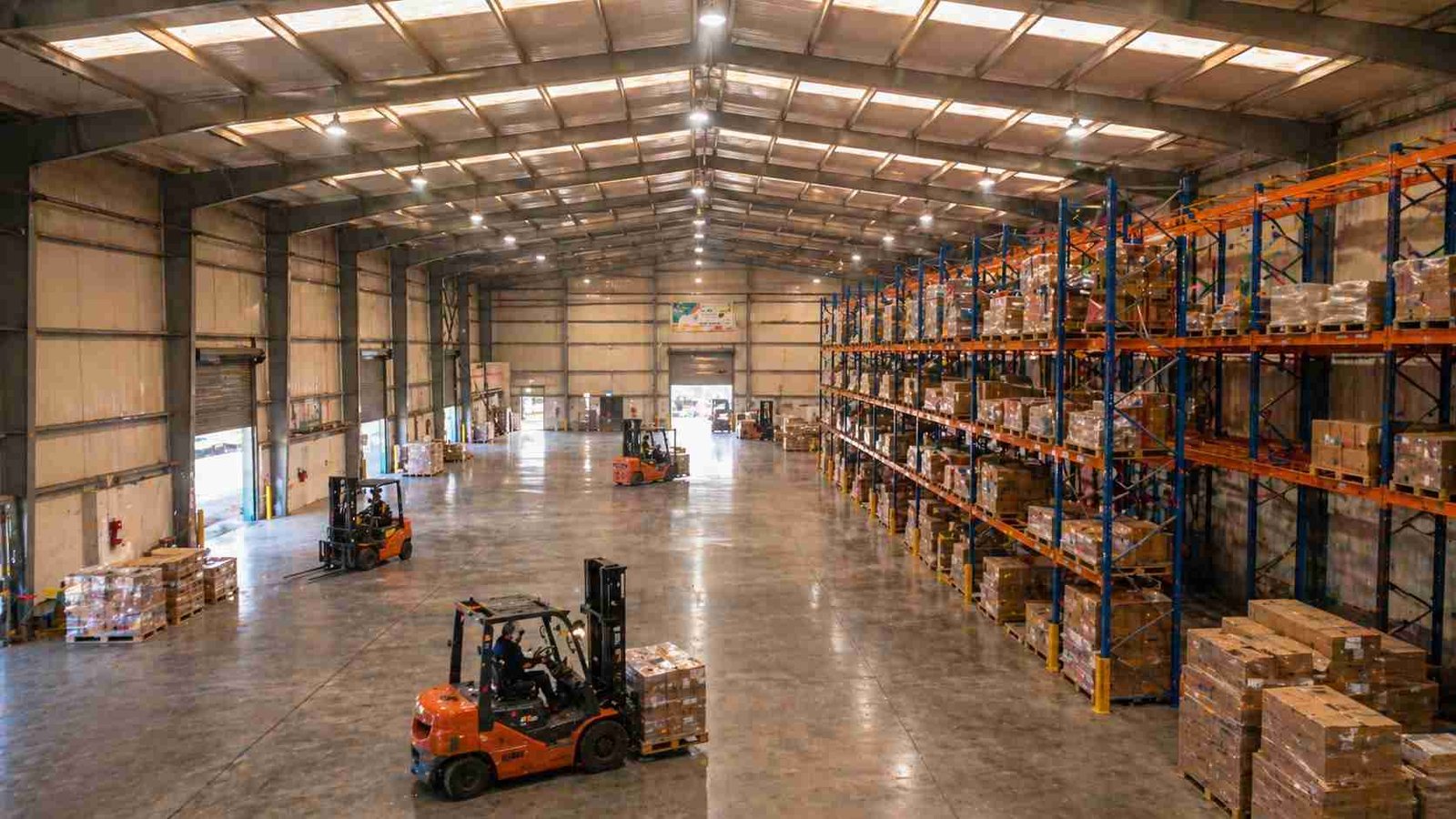
Interior of a SAMAN PEB construction warehouse — 30m clear span with no interior columns. PUF insulated panels, ridge skylights, LED high bay lighting, and epoxy floor. Dock levellers and racking systems integrated into the original structural design.
Cold storage and food processing: Insulated PUF panel structures with temperature-controlled interiors. FSSAI-compatible cladding specification available.
Commercial and industrial complexes: Multi-span and multi-bay commercial buildings. Showrooms, workshops, and combined office-production facilities under a single roof.
Phased and modular expansion: Buildings designed from the outset to accept future bays — end-wall column placement and roof pitch confirmed at design stage so your Phase 2 construction connects without structural modification.
For buyers considering a phased construction approach, our prefab modular construction subpage covers modular expansion design. For buyers comparing structural steel grades and performance specifications, our peb steel structure subpage covers the material and engineering detail. For buyers at the broader building construction evaluation stage, our prefab building construction page covers the full range of construction formats.
If You Need the Structure Supplied Without Erection
If you have your own erection team or a preferred local contractor and need SAMAN to supply the fabricated PEB structure only — without our on-site erection service — that is our separate product supply cluster.
See our pre-engineered buildings page for IS-certified PEB structure supply without construction service.
If your requirement is a simpler single-span industrial shed rather than a full multi-bay PEB construction project, see our industrial sheds page for shed product supply with our erection crew.
Frequently Asked Questions
Does the 45-day timeline include the civil foundation work?
No. The 45-day timeline covers SAMAN’s scope: structural design, fabrication, transport, and erection. Civil foundation work — which your contractor executes using our anchor bolt layout drawing — typically takes 3 to 4 weeks and runs concurrently with our fabrication phase. Total project completion including civil work is typically 50 to 60 days for projects up to 15,000 sq ft.
Does SAMAN construct PEB buildings outside Bangalore and Greater Noida?
Yes. SAMAN constructs PEB buildings across India from our Bangalore and Greater Noida manufacturing facilities. We have completed projects in Karnataka, Tamil Nadu, Andhra Pradesh, Telangana, Maharashtra, Gujarat, Rajasthan, Delhi NCR, Uttar Pradesh, Punjab, and other states. Site access requirements are confirmed before order for remote or difficult terrain locations.
What documentation does the buyer receive at handover?
Every SAMAN PEB construction project handover includes as-built structural drawings, IS 800/875/1893 compliance certificate signed by a licensed structural engineer, mill test certificates for all primary structural steel, erection completion report, 12-month structural warranty certificate from handover date, and painting and coating warranty documentation.
Is EOT crane provision included in the standard construction contract?
EOT crane rail and bracket provision is a design option confirmed at the structural brief stage — it is not a standard inclusion because it changes the primary frame specification, column size, and foundation load. When confirmed at order, crane rail and associated structural provision is included in the SAMAN scope. The EOT crane unit and crane installation are outside SAMAN’s scope and arranged by the buyer separately.
We may need a second production hall adjacent to this building in 18 months — does SAMAN design for that now?
Yes, and confirming it at the structural brief stage costs significantly less than retrofitting later. We design the end-wall column at the expansion end as a flush frame — meaning the future bay bolts directly to the existing structure without demolition or structural modification. The roof pitch at the expansion end is confirmed to accept the incoming bay. Communicating your approximate future area and direction at brief stage adds 1 to 2% to the original project cost at most.
Tell us your project — we will respond with a structural brief and cost estimate within 24 hours.
Share your plot location, required floor area, span preference, eave height, building use, and crane requirement if any. Our structural team will provide a preliminary layout, phase timeline, and project cost estimate.
Call or WhatsApp: +91 97089 89937
Shipping and Delivery Information
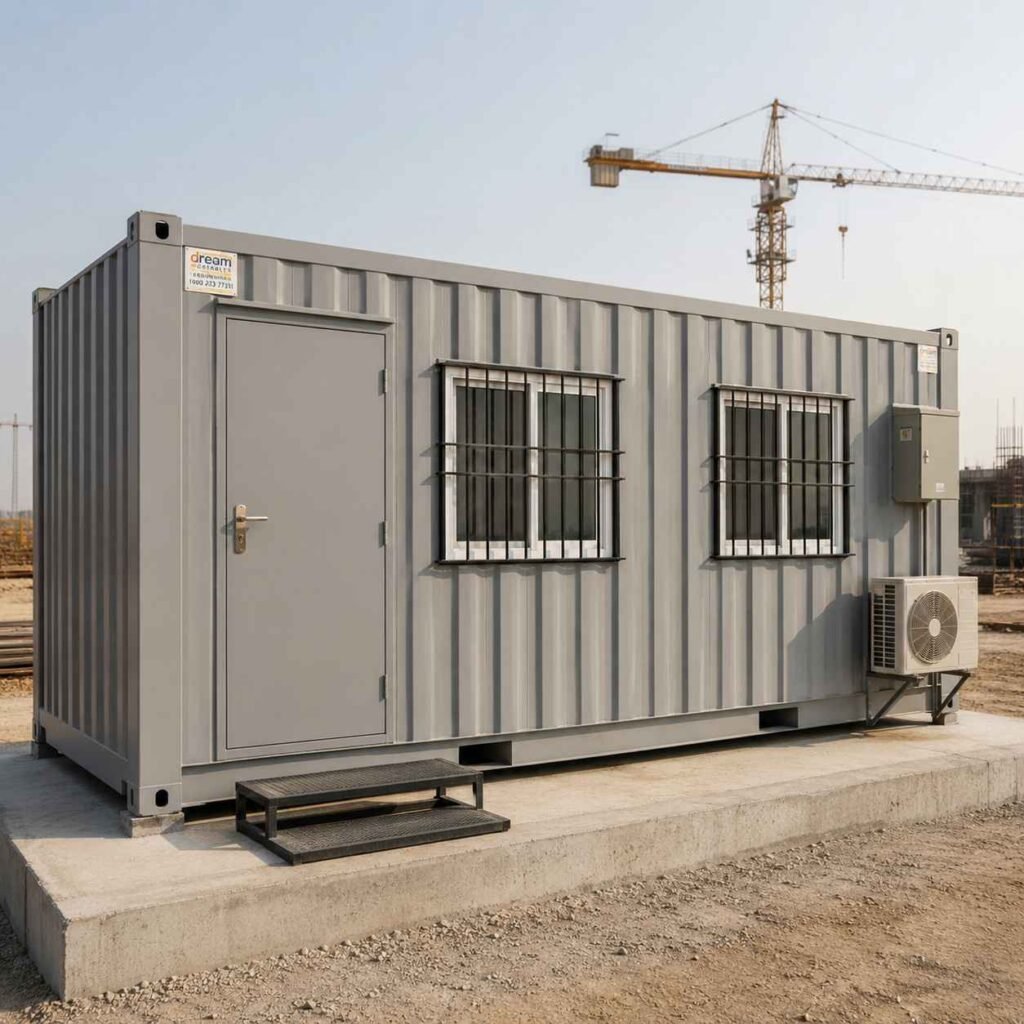
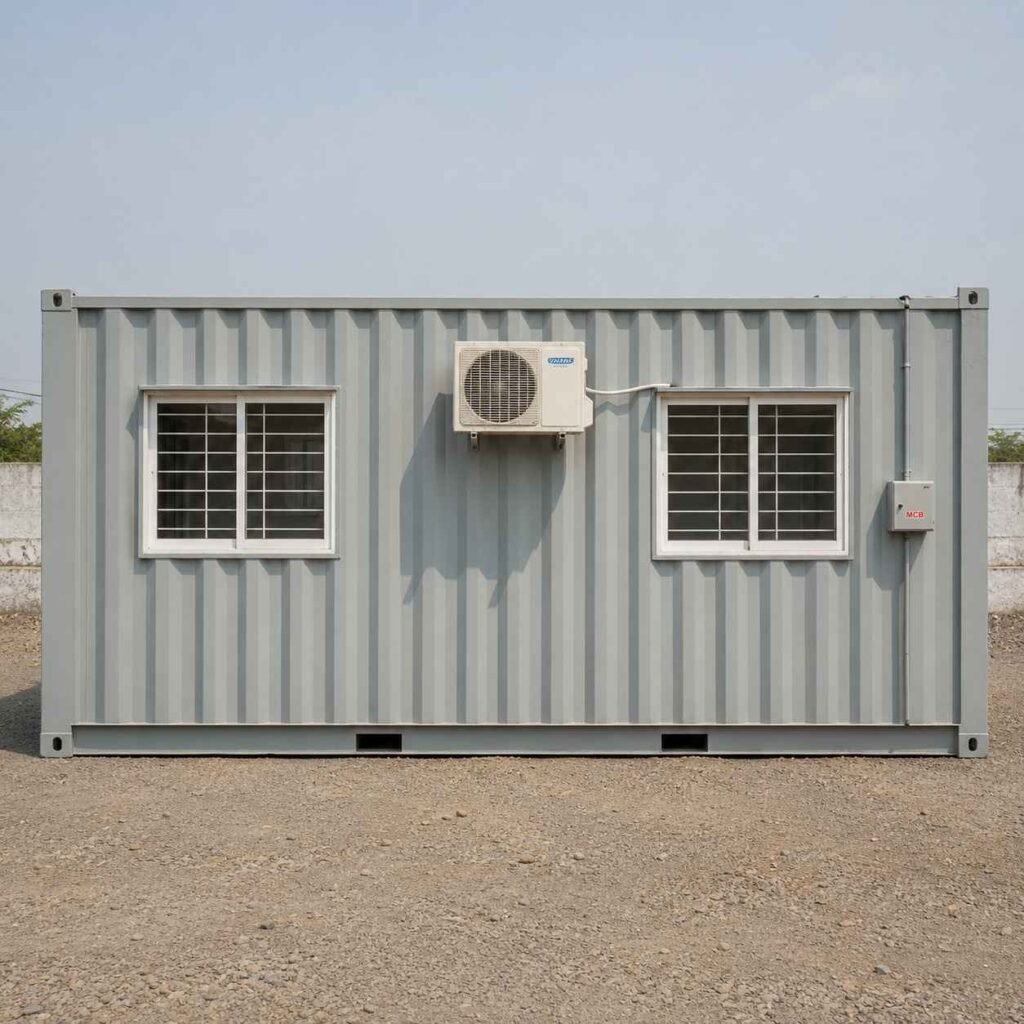
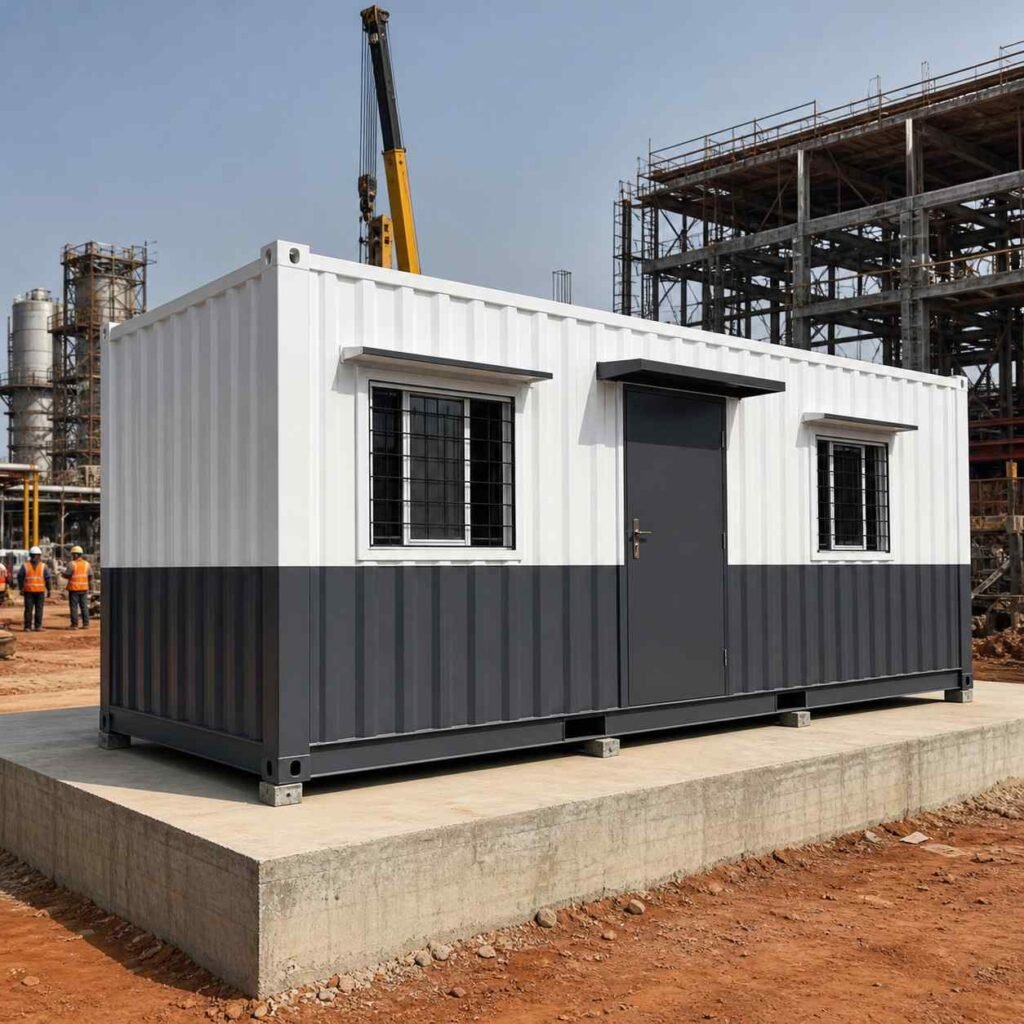
At SAMAN Portable Office Solutions, we are committed to ensuring a seamless shipping experience for our customers. Our shipping and delivery policy has been crafted to provide you with clear details and expectations when you place an order for our portable cabins or container offices.
Delivery Timeline
Once your order is confirmed, we will process and dispatch your product within 15 to 21 working days. This timeline is calculated from the date we receive your order and ensures that your product is fabricated, inspected, and packed securely for transportation. We strive to adhere strictly to this delivery window, guaranteeing that your order reaches you in a timely manner.
Shipping Costs
Our shipping charges are structured based on the size and type of the trailer used for delivery. Below are the detailed rates:
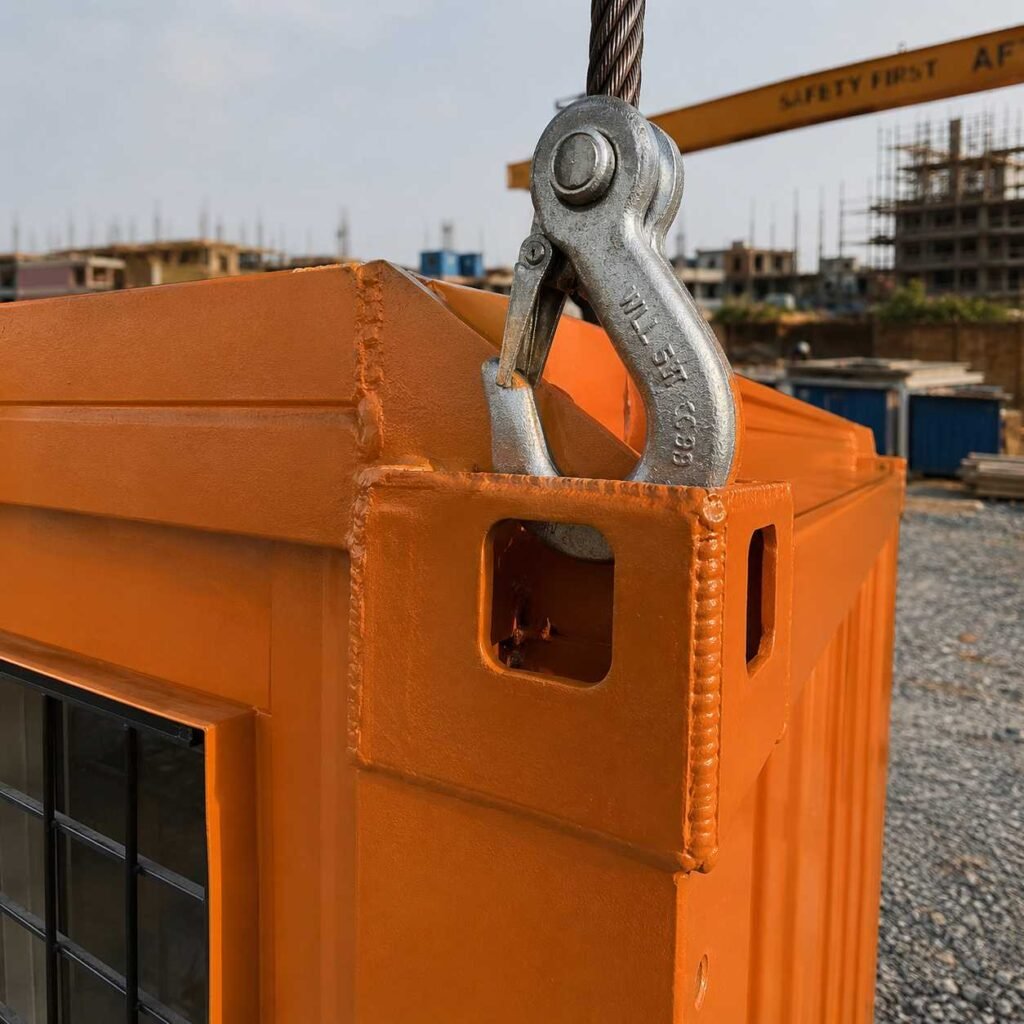
- For a 40 Feet Open Trailer: The cost is ₹80 per kilometer, excluding Over Dimensional Cargo (ODC) and Regional Transport Office (RTO) charges.
- For a 20 Feet Open Trailer: The cost is ₹60 per kilometer, also excluding ODC and RTO fees.
Note: ODC and RTO charges may vary depending on your location and state regulations. We ensure transparency in our billing and will provide you with an accurate estimate before shipment.
Within Bangalore Shipping Rates
For customers within the Bangalore region, we offer competitive fixed shipping rates for hassle-free delivery:
- 40 Feet Open Trailer: ₹15,000
- 20 Feet Open Trailer: ₹10,000
These rates are designed to be cost-effective while ensuring your product reaches its destination safely and securely. We work with reliable transport partners to provide efficient and on-time delivery services within Bangalore.
At SAMAN Portable Office Solutions, customer satisfaction is our priority. For any queries related to shipping or delivery, please feel free to contact our customer support team. We are here to assist you every step of the way.

Reviews
Clear filtersThere are no reviews yet.